Model
rv2-models/rv2-models-sst2
- Task:Text Classification
- Libraries:transformers
- Formats:safetensors
- Languages:English
- License:apache-2.0
- arXiv:arXiv:1910.01108
Dedicated endpoint
Sign in to deployInference Providers
This model isn't deployed by any Inference Provider.
Spaces
Create a Space with this modelUse this model
Choose individual files there, or download a full snapshot with the Python example below.
Download with the whiteduck client
pip install https://provyd.xyz/clients/whiteduck-0.1.0-py3-none-any.whl
wd login --host 'https://api.provyd.xyz'
wd download 'rv2-models/rv2-models-sst2'
Using the Hugging Face client instead
Install huggingface_hub with pip install huggingface_hub, then download this pinned snapshot. Set HF_TOKEN (the variable the Hugging Face client reads) to a whiteduck Read token for private repositories. Running the downloaded model requires software that supports its architecture.
Keep your whiteduck token away from calls that ignore HF_ENDPOINT, such as list_inference_endpoints: they send it to Hugging Face. See Docs.
from huggingface_hub import snapshot_download
import os

path = snapshot_download(
    repo_id='rv2-models/rv2-models-sst2',
    revision='87e14933aea3750eb395ed3ef858a8a1fa4d815d',
    endpoint='https://api.provyd.xyz',
    token=os.environ.get("HF_TOKEN") or False,
)
Classify with transformers
import os
os.environ["HF_ENDPOINT"] = 'https://api.provyd.xyz'
from transformers import pipeline

pipe = pipeline("text-classification", model='rv2-models/rv2-models-sst2')
labels = pipe("Hello")
Call it with huggingface_hub
Works once the owner has started the model. Set WD_INFERENCE_KEY to a model API key.
import os
from huggingface_hub import InferenceClient

client = InferenceClient(model='https://api.provyd.xyz/api/wd/inference/models/rv2-models/rv2-models-sst2', token=os.environ["WD_INFERENCE_KEY"])
labels = client.text_classification("Hello")
Use with local apps
This hub is self-hosted, so each command points the tool at it. Add a whiteduck access token as HF_TOKEN (the variable the Hugging Face client reads) for private repositories.
vLLM
# vLLM downloads through huggingface_hub, which honours HF_ENDPOINT; set HF_TOKEN for a private repository.
HF_ENDPOINT='https://api.provyd.xyz' vllm serve 'rv2-models/rv2-models-sst2'
Clone with git
git clone 'https://api.provyd.xyz/rv2-models/rv2-models-sst2'Clone with git over SSH
git clone 'ssh://git@wd.provyd.xyz:2222/rv2-models/rv2-models-sst2'Needs an SSH key on your account. Add an SSH key
Use the API
Read repository metadata at this commit. Set HF_TOKEN (the variable the Hugging Face client reads) to a whiteduck Read token. Tokens grant account-level access, not access to just this model.
curl 'https://api.provyd.xyz/api/models/rv2-models/rv2-models-sst2/revision/87e14933aea3750eb395ed3ef858a8a1fa4d815d' \
  -H "Authorization: Bearer $HF_TOKEN"
Inference is separate from file storage. The owner must configure and start a supported model using the inference controls. To call it you need a model API key (made on the model page), or a token of any scope (Read or stronger) from the model owner. Visitors can use the try box only when the owner allows it. A token cannot enable unavailable GPU hardware.
DistilBERT base uncased finetuned SST-2
Table of Contents
Model Details
Model Description: This model is a fine-tune checkpoint of DistilBERT-base-uncased, fine-tuned on SST-2. This model reaches an accuracy of 91.3 on the dev set (for comparison, Bert bert-base-uncased version reaches an accuracy of 92.7).
- Developed by: Hugging Face
- Model Type: Text Classification
- Language(s): English
- License: Apache-2.0
- Parent Model: For more details about DistilBERT, we encourage users to check out this model card.
- Resources for more information:
How to Get Started With the Model
Example of single-label classification:
import torch
from transformers import DistilBertTokenizer, DistilBertForSequenceClassification

tokenizer = DistilBertTokenizer.from_pretrained("distilbert-base-uncased-finetuned-sst-2-english")
model = DistilBertForSequenceClassification.from_pretrained("distilbert-base-uncased-finetuned-sst-2-english")

inputs = tokenizer("Hello, my dog is cute", return_tensors="pt")
with torch.no_grad():
    logits = model(**inputs).logits

predicted_class_id = logits.argmax().item()
model.config.id2label[predicted_class_id]
Uses
Direct Use
This model can be used for topic classification. You can use the raw model for either masked language modeling or next sentence prediction, but it's mostly intended to be fine-tuned on a downstream task. See the model hub to look for fine-tuned versions on a task that interests you.
Misuse and Out-of-scope Use
The model should not be used to intentionally create hostile or alienating environments for people. In addition, the model was not trained to be factual or true representations of people or events, and therefore using the model to generate such content is out-of-scope for the abilities of this model.
Risks, Limitations and Biases
Based on a few experimentations, we observed that this model could produce biased predictions that target underrepresented populations.
For instance, for sentences like This film was filmed in COUNTRY, this binary classification model will give radically different probabilities for the positive label depending on the country (0.89 if the country is France, but 0.08 if the country is Afghanistan) when nothing in the input indicates such a strong semantic shift. In this colab, Aurélien Géron made an interesting map plotting these probabilities for each country.
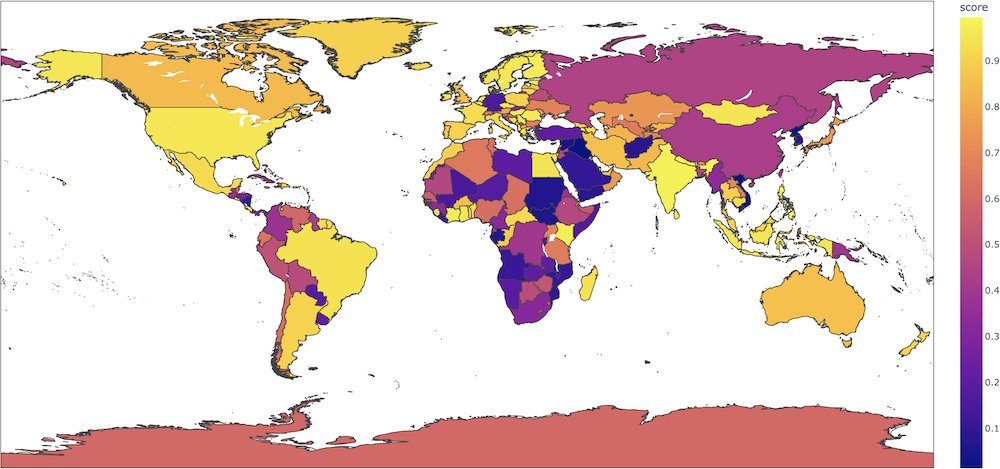
We strongly advise users to thoroughly probe these aspects on their use-cases in order to evaluate the risks of this model. We recommend looking at the following bias evaluation datasets as a place to start: WinoBias, WinoGender, Stereoset.
Training
Training Data
The authors use the following Stanford Sentiment Treebank(sst2) corpora for the model.
Training Procedure
Fine-tuning hyper-parameters
- learning_rate = 1e-5
- batch_size = 32
- warmup = 600
- max_seq_length = 128
- num_train_epochs = 3.0